-
Upcoming Design Sneak Peek
I have just finished the sample of an oversized cardigan. It is one of the rare time that as soon as I finished a project I want to make another one in another color! I love the fit of this cardigan and it is just the perfect garment for this season. I will run a test knit soon. If you are interested, come join my Ravelry group to stay tuned on when the test begins.
-
Alternative to Mattress Stitch
I like seamed designs. Seams add structure to a garment. As I knit mostly outside the home, I prefer working on a smaller pieces rather than dragging the whole garment everywhere. But I have a problem: I really dislike Mattress Stitch. I dislike its name, dislike the awkward position at which I have to work it. So what is the alternative? Basic running stitch or back stitch! You only have to remember to work it with wrong side facing (i.e. right sides together). Back stitch is more elastic but more bulky. If you use running stitch and are careful enough to match the edges stitch by stitch, the result is…
-
One-Row Buttonhole
My favorite buttonhole is a simple twisted yarn over. But when I need a bigger one, a one-row buttonhole is my preferred technique. Below is an excerpt from my pattern Minimissimi Sweater Coat. Step 1: Work to the buttonhole position, slip 1 stitch knitwise, bring the yarn to the front and drop it (upper left). *Slip 1 stitch knitwise (upper middle), pass the previously slipped stitch over the just slipped stitch. One stitch bound off. Repeat from * to bind off the required number of buttonhole stitches (upper right). Step 2: Return the last stitch to the left needle. Turn work. Bring yarn forward. *Insert the right needle…
-
Favorite on-the-go knitting patterns
I don’t knit much at home. Most of my knitting is done at my in-laws place or at the seaside, where my toddler is kept busy. So it is almost a must to have a on-the-go knitting project on my needles. A good on-the-go knitting project should be lightweight to be carried around and it should not be a too quick knit that can be finished in a couple of hours. I don’t want to run out of knitting! That’s why you constantly see this type of designs pops up in my portfolio 😉 Below are some on-the-go projects that I enjoyed. If you cannot live without knitting, you may…
-
Wee Closer Cowl
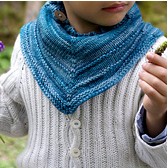
Wee Closer Cowl — € () or This cowl is a toddler version of Closer. This no-fuss cowl will keep your little one warm, and is perfect for the active toddler. Draping deeply at both front and back, it uses only a tiny bit of sport weight yarn. Like its grown-up version, it is easy to make it larger or smaller. Measurements are given in both centimeters and inches. MATERIALS YARN Sport weight Shown here: Malabrigo Arroyo (100% Merino; 306 m/335 yds, 100 g/3.5 oz hank; color #133 Reflecting Pool): 1 skein Yardage: 120 m / 130 yds, including 10% allowance NEEDLES 3.5 mm / US 4 circular needle of…
-
The impossible mission – writing a perfect pattern
As a designer, I want my patterns to be as perfect as humanly possible. Whenever I see room for improvement in a pattern, I rewrite part of it. As an independent designer, I’m after quality and not quantity. When you have too many designs, it becomes impossible to review all of them regularly. By the time a pattern is ready for purchase, it has already been reviewed many many times by me, my technical editors and test knitters. But errors can still slip through, especially simple typos that our brains are incredibly good at auto-correcting. Recently I have started adding version numbers to my patterns. I have added a page…
-
Spring KAL
Spring is a good time for KAL (Knit-along)! After all the winter knitting, it’s time for a quick accessory. I have just released Closer Cowl and I am hosting a KAL for it in my Ravely group. The KAL will run from the 1st of May to the 15th of June with prizes for everyone! Come join us for fun! See you there! What is a KAL? A KAL is where several knitters knit the same thing at the same time. You can share your progress, yarn choice or whatever related to the project in the KAL thread. Or you can ask questions if you are stuck. You can post…
-
Closer Cowl
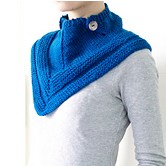
Closer Cowl — € () or Closer is a cowl that drapes deeply at both front and back. It will keep the chill out over the lowest-cut neckline. You can make a statement piece by pairing it with some unique buttons. Using just 165 m / 180 yds of yarn, this is an ideal stash buster project. It is easy to make it larger or smaller, too! Measurements are given in both centimeters and inches. MATERIALS YARN Worsted weight Shown here: Knit Picks Swish Worsted (100% Merino; 101 m / 110 yds, 50 g / 1.75 oz skein; Color Marine Heather: 2 skeins) Yardage requirement: 165 m / 180 yds…
-
Diverting Scarf
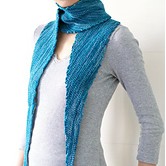
Diverting Scarf — € () or → See it on Ravelry Diverting Scarf is a reversible garter stitch scarf. Shaped as a parallelogram and worked on the bias, this scarf uses an intriguing technique that involves only cast-on, bind-off and knit stitch; no increase, decrease nor short-rows are used. It makes a great on-the-go mindless project. Have fun with your knitting! FINISHED SIZE The finished scarf measures 168 cm / 66″ in length (tip to tip) and 12.5 cm / 5″ in width. MATERIALS YARN Sport weight Shown here: Malabrigo Arroyo (100% Merino; 306 m/335 yds, 100 g/3.5 oz hank): 1 skein Yardage: 280 m / 305 yds, including 10%…
-
Choosing patterns for plus sizes
A sweater in size 2XL is not an enlarged version of the sample size. When grading is not done properly, you will get an unrealistically wide shoulder width, exceptionally long neck to waist measurement, etc. I had a hard time picking a good pattern when I was looking for a pattern for a plus size friend. Fortunately it is relatively easy to identify a poorly graded pattern from the schematic measurements. It won’t take you much time and will potentially help you save a huge amount of frustration. The key measurements to compare are shoulder width (or back width), back length (neck to natural waist) and armhole depth. You can…